
August 22, 2026 · 10 min read
ADHICS V2 Guide for Abu Dhabi Healthcare SaaS
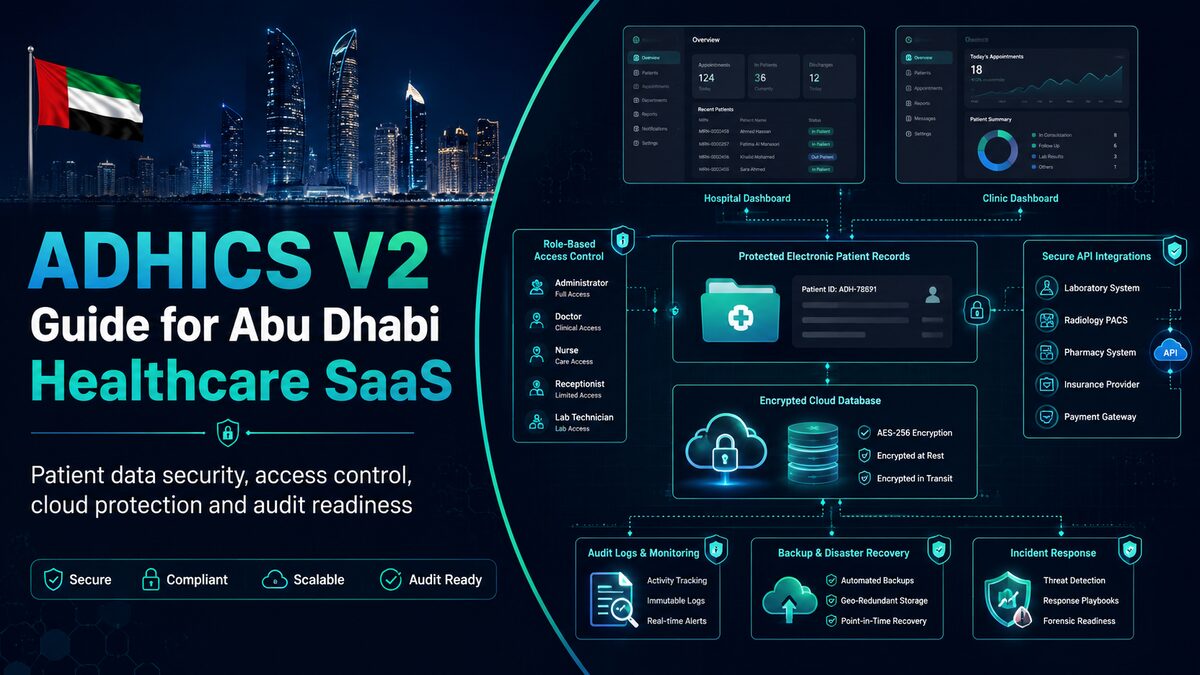
ADHICS V2 compliance for Abu Dhabi healthcare SaaS starts long before an audit. It affects how a product identifies users, separates patient records, stores files, logs activity, connects to vendors, responds to incidents and proves that its controls actually work.
The Department of Health Abu Dhabi runs the AAMEN programme to protect sensitive patient healthcare data. Its official page lists the Abu Dhabi Healthcare Information and Cyber Security Standard V2, or ADHICS V2, as the current standard. It also says older standalone patient-data privacy and Internet of Medical Things requirements have been retired and addressed within ADHICS V2.
That matters to hospitals, clinics, diagnostic centres and digital-health teams, but it also matters to SaaS vendors selling into this market. A healthcare organisation cannot outsource its risk by buying software. It will ask where patient data goes, who can access it, which subcontractors are involved, how incidents are handled and what evidence the vendor can provide.
I build multi-tenant SaaS platforms with authentication, role-based permissions, APIs, databases, audit trails and third-party integrations. Those are useful foundations, but they are not automatic ADHICS certification. This guide explains how I would translate healthcare security requirements into a practical product architecture. It is technical guidance, not legal advice or an audit opinion.
What ADHICS V2 means for healthcare SaaS in Abu Dhabi
The AAMEN programme aims to help Abu Dhabi healthcare facilities protect the confidentiality, accuracy and availability of healthcare information. Its strategy covers governance, resilience, capabilities, partnerships, maturity and innovation. The programme also operates with Abu Dhabi Healthcare CERT for advisories, threat intelligence, incident management, forensic assessment and vulnerability assessment.
At federal level, UAE health-sector rules add another layer. The official UAE government portal explains that Federal Law No. 2 of 2019 regulates information and communication technology in healthcare, including free zones. It requires health information to remain confidential, protected against unauthorised change or destruction, and available to authorised parties when needed.
A SaaS team should therefore avoid reducing ADHICS V2 to a penetration test or a policy folder. Security governance, application controls and operational evidence need to support each other.
Confirm your real scope before designing controls
Start by identifying every system that creates, receives, stores, processes or transmits Abu Dhabi health information. Include the patient portal, clinician dashboard, mobile app, API, primary database, file storage, backups, analytics, support desk, email delivery, monitoring and AI services.
Then document the organisations involved. The healthcare entity may own the care relationship while the SaaS provider hosts or processes information on its behalf. Cloud providers, messaging services and support tools may become additional dependencies. DoH applicability, contracts and the latest AAMEN material should be reviewed with the healthcare entity and a qualified assessor rather than guessed by the development team.
Build an ADHICS V2 data map before writing code
A data-flow map is the fastest way to expose hidden risk. Draw where information enters, where it is stored, every service that receives it, and how it is archived or deleted. Mark health information, identity data, payment data, operational metadata and truly anonymous metrics separately.
For each flow, record the business purpose, owner, users, storage region, encryption method, retention rule, backup behaviour and vendor. Do not stop at the production database. Patient names frequently leak into logs, filenames, exported spreadsheets, support screenshots, notification messages and error-monitoring payloads.
Classify data and minimise collection
Not every feature needs a complete patient profile. A reminder service may need a delivery destination and appointment reference, but not a diagnosis. An analytics dashboard may work with aggregated counts rather than identifiable records.
Define allowed data categories for each service. Block sensitive fields from logs and analytics by default. Use generated identifiers in internal events. If developers need realistic test data, create synthetic records instead of copying production information into local laptops or shared staging environments.
Map cloud and cross-border dependencies
The DoH Policy on Digital Health says healthcare entities must follow cloud-related data-privacy requirements and address health data housed in Abu Dhabi and on external servers. A UAE cloud region can support a residency decision, but it does not keep every data flow inside the country automatically.
Check database replicas, backups, content-delivery logs, support access, email providers, observability tools and AI APIs. Record the configured region and the contractual location, not just the vendor's headquarters. Make residency and transfer decisions with the healthcare organisation and its advisers before deployment.
Enforce patient-data access inside the API and database
The highest-risk SaaS bug is often simple: a logged-in user changes an ID and receives another patient's or clinic's record. Hiding a button in the browser does not prevent this. Every request must enforce tenant, role and resource scope on the server.
Use least privilege. A receptionist, clinician, billing user, support engineer and system administrator should not receive the same access. Separate ordinary support from privileged production access, require stronger authentication for sensitive actions, and make temporary elevation expire automatically.
Use deny-by-default authorization
async function getPatientRecord(request, recordId) {
  const session = await requireSession(request)
  const record = await db.patientRecord.findUnique({ where: { id: recordId } })

  if (!record || record.facilityId !== session.facilityId) {
    throw new NotFoundError()
  }

  const allowed = await permissions.can(session.userId, 'patient.read', {
    facilityId: record.facilityId,
    patientId: record.patientId
  })

  if (!allowed) throw new ForbiddenError()

  await audit.record('patient.record_viewed', {
    actorId: session.userId,
    facilityId: session.facilityId,
    recordId: record.id
  })

  return redactForRole(record, session.role)
}
This example checks the facility boundary, permission and returned fields before sending data. It also creates a structured audit event. In production, avoid logging clinical content inside that event. Record who performed the action, what resource was involved, when it happened and whether it succeeded.
For PostgreSQL or Supabase applications, database-level row security can add a second boundary. My Supabase RLS guide for multi-role SaaS explains the same tenant-isolation principle in more detail.
Protect service accounts and integrations
Machine identities deserve the same discipline as human users. Give each integration its own credentials and minimum permissions. Keep secrets outside source control, rotate them, restrict their network use where practical, and alert on unusual access.
Never use one unrestricted API key across every clinic. If that key leaks, the blast radius becomes the entire platform. Facility-scoped credentials, short-lived tokens and signed webhook validation make containment easier.
Secure health data throughout its lifecycle
Encrypt traffic between browsers, APIs and service dependencies. Encrypt databases, object storage and backups using managed keys or an approved key-management design. Encryption is only useful when key access is restricted, rotation is planned and recovery has been tested.
Define retention by data category. A product should know when records become inactive, which information must be retained, who approved the rule and how deletion propagates to files, search indexes, caches and vendors. Do not advertise deletion if old copies remain indefinitely in exports or unmanaged backups.
Design secure uploads and exports
Healthcare SaaS often handles reports, scans and images. Validate file type and size, scan uploads where required, generate storage names rather than trusting filenames, and keep objects private. Serve files through authorised, short-lived URLs instead of permanent public links.
Exports need extra protection because one archive can contain thousands of records. Require a fresh authorization check, generate the file in a controlled background job, encrypt it in transit, expire the download quickly and record the request and download. Test that users cannot guess another export ID.
Keep backups recoverable and protected
Availability is a security requirement in healthcare. Backups should be encrypted, access-controlled and separated from ordinary production credentials. A successful backup job is not proof of recovery. Run restore tests, record the result and measure whether the recovered service meets the healthcare organisation's recovery objectives.
Turn logging into audit evidence without leaking data
ADHICS V2 readiness depends on evidence. Policies describe the intended control; logs, tickets, reviews and test results show whether the control operates.
Use structured security events for logins, failed authentication, permission changes, record access, exports, administrative actions, API-key creation and deletion requests. Protect audit records against ordinary modification and define who can search them.
At the same time, minimise their content. Never log passwords, access tokens, full patient records or request bodies containing clinical information. Mask identifiers where operational teams do not need them. Set retention deliberately instead of leaving every logging service on its default.
Monitor what matters
Create alerts for repeated failed logins, impossible role changes, bulk exports, unusual service-account access, disabled security controls and unexpected data movement. Tune alerts using real application behaviour so the team does not ignore a constant stream of noise.
Security monitoring needs ownership. Each important alert should have a severity, response target, escalation contact and investigation playbook. If nobody is responsible after business hours, an alert is only a dashboard decoration.
Manage vendors, AI features and connected medical systems
A SaaS vendor inherits risk from its own suppliers. Maintain a current list of subprocessors and connected services. For each one, document the information shared, purpose, region, security commitments, incident contact, deletion process and exit plan.
Review changes before enabling a new SDK. A developer can add an analytics or chat package in minutes, but that package may receive patient page URLs, identifiers or form content. Technical review should happen before data starts flowing.
Treat AI prompts as a health-data flow
An AI assistant for clinicians or patients can send symptoms, notes and documents to a model provider. Apply the same classification, access control, minimisation, vendor review and retention rules used elsewhere.
Retrieve only records the authenticated user can access. Remove unnecessary identifiers, separate tenants, control prompt logging and test for data leakage between conversations. Human review and clear limitations are important where output may affect care. The DoH strategy supports innovation and AI adoption, but innovation still sits inside the healthcare security framework.
Secure interoperability and webhooks
Healthcare platforms frequently exchange data with laboratories, insurers, identity systems and health-information exchanges. Validate message schemas, authenticate both ends, sign webhooks, reject replayed requests and record delivery status without logging sensitive payloads.
Use idempotency keys so retries do not create duplicate clinical or billing events. Define what happens when a dependency is unavailable: queue safely, show an honest status and reconcile later instead of silently dropping the transaction.
Prepare incident response and business continuity before launch
The AAMEN programme includes Healthcare CERT capabilities for incident management, forensics, threat intelligence and vulnerability assessment. A SaaS provider should know how it will support the healthcare entity if an incident occurs.
Create a response plan covering detection, triage, containment, evidence preservation, recovery, communications and regulatory assessment. Keep current contacts for the healthcare customer, cloud providers and critical vendors. Legal and notification decisions belong to authorised specialists, but engineering must quickly provide accurate facts.
Run realistic exercises
Test scenarios such as a compromised support account, an exposed storage bucket, ransomware affecting a clinic integration, or one facility receiving another facility's export. Measure how long it takes to disable access, identify affected records, restore service and produce a reliable timeline.
Track every gap as an owned remediation item. An exercise is valuable when it changes the system or playbook, not when it ends with a presentation saying the test passed.
ADHICS V2 healthcare SaaS checklist
- Confirm scope with the Abu Dhabi healthcare entity and qualified ADHICS advisers.
- Map every health-data flow, vendor, storage region and privileged user.
- Classify data and collect only what each feature needs.
- Enforce facility, patient and role scope in the API and database.
- Use strong authentication and controlled temporary administration.
- Encrypt traffic, storage, files and backups with managed key access.
- Build safe upload, export, retention and deletion workflows.
- Keep audit logs useful while excluding clinical content and secrets.
- Monitor high-risk behaviour with owned response playbooks.
- Assess cloud services, AI providers and other subprocessors before use.
- Secure webhooks and integrations against tampering, replay and duplication.
- Test vulnerabilities, backup restoration, incident response and continuity.
- Keep evidence such as reviews, tickets, test reports and remediation records.
Practical takeaway
ADHICS V2 compliance for Abu Dhabi healthcare SaaS is not one feature. It is a chain of technical and operational controls protecting health information from collection through deletion.
Start with scope and data flows. Then build tenant isolation, least-privilege access, encryption, safe files, controlled vendors, useful audit evidence and tested incident response. Review the architecture with the healthcare organisation, the latest DoH material and qualified assessors before claiming compliance.
Use the official Department of Health AAMEN page, the official ADHICS V2 standard, the UAE government health ICT overview and the DoH Policy on Digital Health as primary references.
If you need a secure healthcare SaaS platform, patient portal or Node.js integration for an Abu Dhabi organisation, contact me to discuss the architecture.
Written by Muhammad Mustafa — Full-Stack SaaS Engineer
Get in touch