Published · 10 min read
Dubai AI Seal Guide for AI SaaS Companies in 2026
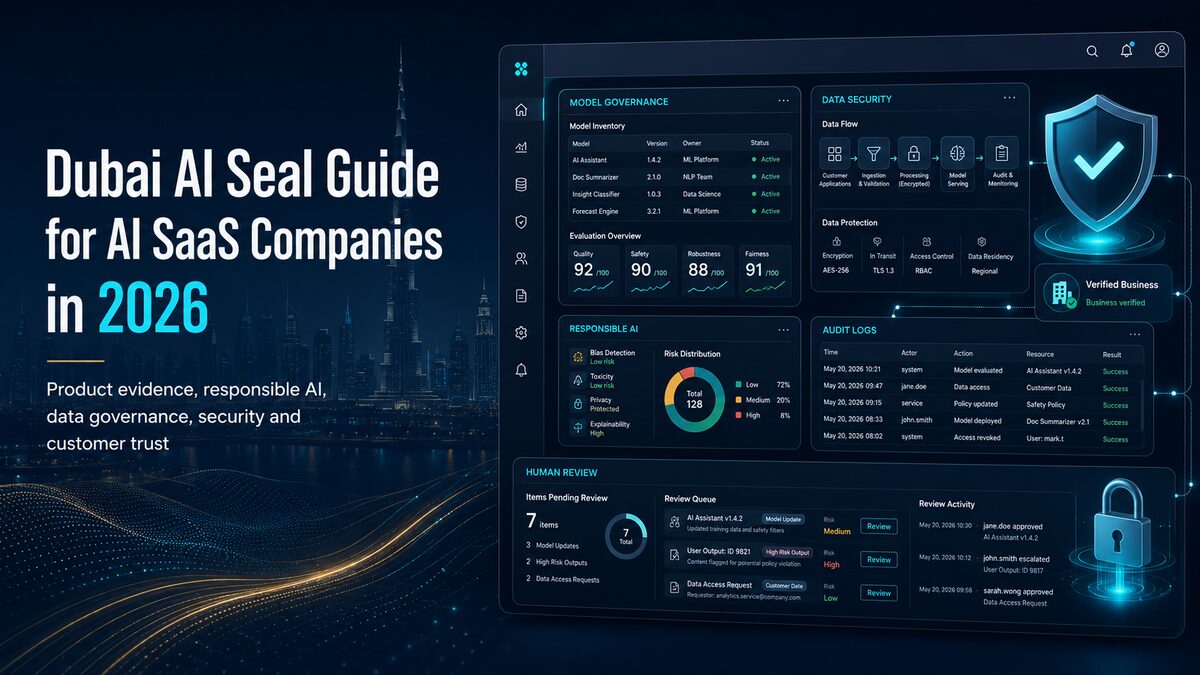
The Dubai AI Seal for AI SaaS companies is more than a badge for a website. It is a verification initiative from the Dubai Centre for Artificial Intelligence that helps government entities and private businesses identify companies genuinely providing artificial intelligence products and services.
The official Dubai AI Seal page says legally operating AI businesses of any size can apply. Approved companies receive a personalised seal with a tier and unique serial number. The programme is free, and the six tiers run from E to S, reflecting the nature of the company's activities, its projects and its economic contribution to Dubai's AI economy.
That creates a useful opportunity for AI SaaS companies in Dubai, but it also raises a practical question: what should a technical team prepare before presenting its product as a trustworthy AI solution?
I build production SaaS systems with LLM integrations, retrieval, multi-tenant data, authentication, billing and audit trails. I have not claimed or applied for the Dubai AI Seal, so this article does not pretend to reveal a private scoring formula. Instead, it uses the official public information and responsible AI engineering practices to explain how I would make an AI SaaS product easier to verify, explain and trust.
What the Dubai AI Seal means for AI SaaS companies
The Dubai AI Seal was created to classify and verify trusted AI companies. Its official objectives include giving businesses and government entities an accessible way to verify AI suppliers, recognising economic contribution and reducing the noise created by irrelevant providers or AI washing.
AI washing happens when a company describes ordinary automation or a thin third-party wrapper as a substantial AI capability. A serious AI SaaS provider should be able to explain what its AI actually does, which part of the workflow depends on a model, how performance is measured, where human decisions remain and what happens when the system is uncertain.
The Dubai Centre for Artificial Intelligence assesses applications using the Dubai AI Business Activity Classification System. The public website does not publish a guaranteed evidence checklist or promise a particular tier. Therefore, companies should rely on the current application portal for official requirements and treat the preparation below as technical readiness, not a shortcut to approval.
Who can apply
The programme is open to local, regional and international companies licensed to operate in Dubai that offer AI-based products or services or incorporate AI into their offerings. In May 2025, Dubai Future Foundation reported that 325 companies representing 77 international offices had applied. That dated figure shows meaningful interest, but applicants should check the official site for the latest programme status.
A company should first confirm that its trade licence and business activities accurately cover the work it performs. Product branding cannot repair an incorrect legal setup. Questions about licensing belong with the relevant Dubai authority or a qualified business adviser.
Why verification matters commercially
Enterprise buyers do not purchase an AI demo; they purchase an operating system they can depend on. Procurement teams may ask about privacy, model providers, security, support, service continuity, data locations and measurable results. A clear technical evidence package answers those questions faster.
The seal may improve credibility and visibility, but it should not be presented as proof that every output is accurate, every integration is secure or every legal obligation is satisfied. Trust still depends on the specific product, contract, deployment and controls.
Build a clear AI product evidence package
Start by describing the product in plain English. Identify the user, business problem, AI-supported task and measurable outcome. Separate model-powered features from deterministic software such as authentication, billing, workflow rules and reporting.
For example, an Arabic customer-support platform may use an LLM to understand questions and draft responses, retrieval to find approved company information, fixed rules to protect account actions and a human agent for escalation. That description is more credible than saying the platform uses an advanced proprietary AI engine if most intelligence comes from an external API.
Document the production architecture
Create a current diagram covering the user interface, API, identity provider, tenant database, file storage, retrieval pipeline, model provider, background jobs, monitoring and human support. Mark which systems receive personal, confidential or customer-controlled data.
Document model names or model families, configured regions where relevant, fallback behaviour, rate limits and version-change controls. If the product can switch providers, explain how evaluations are repeated before a new model receives production traffic.
A technical reviewer should be able to answer four questions from the diagram: where data enters, where it goes, what makes a decision and how a person can intervene.
Show that the product is real
Prepare a controlled demonstration using realistic but non-sensitive data. Show the complete workflow, not only the best prompt. Include authentication, tenant separation, a normal successful response, a refusal, a low-confidence case, a failed dependency and human escalation.
Keep supporting evidence such as release notes, evaluation results, architecture decisions, security-test reports and incident exercises. Do not manufacture customer numbers, accuracy percentages or case studies. If a result comes from a limited pilot, label the scope and sample honestly.
Record AI actions without storing every secret
AI audit records should explain how a response was produced without copying sensitive prompts and documents into unrestricted logs. A practical event can record the tenant, feature, model version, prompt-template version, retrieval references, policy result, latency and escalation outcome.
type AiAuditEvent = {
  tenantId: string
  feature: 'support_answer' | 'document_summary'
  modelVersion: string
  promptVersion: string
  retrievedDocumentIds: string[]
  policyResult: 'allowed' | 'blocked' | 'needs_review'
  humanEscalation: boolean
  latencyMs: number
  createdAt: string
}

await auditStore.write({
  tenantId: session.tenantId,
  feature: 'support_answer',
  modelVersion: response.model,
  promptVersion: ACTIVE_PROMPT_VERSION,
  retrievedDocumentIds: safeReferenceIds,
  policyResult,
  humanEscalation: policyResult === 'needs_review',
  latencyMs: Date.now() - startedAt,
  createdAt: new Date().toISOString()
})
The event supports investigation and evaluation while avoiding raw customer conversations. Access to audit data should be restricted, retention should be defined, and identifiers should be minimised.
Prepare responsible AI, data and security controls
Dubai's wider AI direction connects adoption with governance, data quality, privacy and operational readiness. Digital Dubai's 2026 AI Integration Matrix says successful implementation depends on more than models and applications; data quality and governance are fundamental. The updated Dubai Data Manual also treats governed, high-quality data as a strategic foundation for AI.
An AI SaaS company should therefore treat responsible AI controls as product features rather than presentation slides.
Define approved and prohibited uses
Write a short policy for each AI feature. State the intended users, supported tasks, known limitations and decisions the system must not make alone. Add stricter controls for health, finance, employment, identity or other high-impact contexts.
Translate the policy into software. Restrict tools and data sources by role. Block unsafe actions. Require confirmation before sending messages or changing records. Route high-risk or uncertain cases to a person.
Protect customer data and tenant boundaries
Map every field sent to a model, vector database, analytics tool and support platform. Remove information the feature does not need. Confirm provider retention, training and regional settings contractually rather than relying on marketing copy.
In a multi-tenant product, retrieval must filter by the authenticated organisation before documents reach the model. Never ask the model to enforce tenant separation inside the prompt. Authorisation belongs in the API and database. My UAE PDPL checklist for SaaS applications covers the wider privacy workflow, including consent, user rights, vendors and data transfers.
Evaluate quality in English and Arabic
A Dubai AI SaaS product may serve Arabic, English and mixed-language conversations. Test real user phrasing, Gulf terminology, spelling variations, right-to-left interfaces and code-switching. A model that performs well on polished English examples may fail on the language customers actually use.
Build an evaluation set from approved, anonymised scenarios. Measure task completion, groundedness, refusal behaviour, retrieval quality and escalation. Review errors by category instead of hiding them inside one average score.
Run the same evaluation when the prompt, model, retrieval settings or knowledge base changes. Version the results so the team can explain why a production release was approved.
Test security beyond the login page
AI systems add threats such as prompt injection, unsafe tool calls, knowledge-base poisoning and sensitive-data leakage. Test whether an uploaded document can override instructions, whether one tenant can retrieve another tenant's content, and whether the model can trigger an action without proper server-side permission.
Apply ordinary SaaS security too: strong authentication, least privilege, encrypted transport and storage, secret management, dependency patching, rate limiting, backup recovery and incident response. AI does not replace these controls; it expands the attack surface around them.
Turn readiness into a strong Dubai AI Seal application
Use the current official portal, because programme questions and required fields can change. Keep company, licence, product and contact details consistent across the application, trade records and website.
Explain the product without exaggerated claims. Name the business problem, AI capability, target market, current deployment status and contribution to Dubai. Where possible, attach or reference evidence that can be verified.
Prepare an application folder
- Current Dubai trade-licence and company information.
- A plain-English product and AI capability description.
- Production architecture and data-flow diagrams.
- Model, provider and version-management documentation.
- Responsible AI and prohibited-use policies.
- Security, privacy and tenant-isolation controls.
- English and Arabic evaluation results where relevant.
- Human oversight, refusal and escalation workflows.
- Release notes, monitoring examples and incident procedures.
- Truthful customer evidence or clearly labelled pilot results.
- A concise explanation of economic activity and contribution in Dubai.
This is a practical preparation list, not an official promise that every item is required or sufficient. Remove confidential credentials and customer data before sharing any document. Provide sensitive material only through an approved channel.
Use the seal correctly after approval
The official programme says approved companies receive a personalised seal containing a tier and unique serial number that others can verify. Use only the issued asset and accurate tier. Link to verification where the programme permits it, and do not redraw the mark or imply approval for an unrelated product.
Keep the evidence current after approval. Review the architecture when providers change, repeat evaluations, close security findings and update policies. A trustworthy supplier should remain verifiable after the application date.
Dubai AI Seal readiness checklist
- Confirm the company is legally licensed to operate in Dubai.
- Describe the genuine AI capability without AI washing.
- Separate model behaviour from normal SaaS automation.
- Document the production architecture and every data flow.
- Identify model providers, versions, regions and fallbacks.
- Maintain responsible-use and prohibited-use rules.
- Enforce tenant isolation and permissions outside the model.
- Minimise customer data sent to AI and analytics vendors.
- Evaluate quality, grounding, refusals and Arabic performance.
- Test prompt injection, data leakage and unsafe tool execution.
- Provide human review and escalation for uncertain cases.
- Keep truthful product, customer and economic-impact evidence.
- Use only the official issued seal and verifiable serial number.
Practical takeaway
The Dubai AI Seal gives legitimate AI SaaS companies a useful route to demonstrate that they are real participants in Dubai's AI economy. The strongest preparation is not a polished application alone. It is a product whose architecture, data use, evaluation, security and human oversight can be explained with evidence.
Start with an honest product description and data-flow diagram. Then close the gaps in tenant isolation, model evaluation, Arabic testing, security, logging and escalation. Confirm official requirements through the latest application portal and avoid promising a tier before the Dubai Centre for Artificial Intelligence completes its assessment.
Use the official Dubai AI Seal page, the Dubai Future Foundation programme update, the Digital Dubai AI Integration Matrix announcement and the updated Dubai Data Manual announcement as primary references.
If you need an AI SaaS platform, secure RAG workflow or production LLM integration for a Dubai business, contact me to discuss the architecture.

About Muhammad Mustafa
Full-Stack SaaS & AI Engineer with 10+ years of experience building production web applications, multi-tenant platforms, secure integrations and AI-powered products.